Download Obsidian App
Free for Every Platform
The free and flexible app for your private thoughts. Version 1.12.7 — Windows, macOS, Linux, iOS & Android.
Version 1.12.7 • Free for personal use • No account required
Why Download Obsidian? Key Features
Obsidian Download — Free & Private
Download Obsidian for free for personal use. All your notes are stored locally as plain Markdown files — no cloud, no subscription required.
Obsidian for Windows, macOS & Linux
One app, every desktop platform. The Obsidian download is available as a Windows .exe, macOS .dmg, and Linux AppImage, Snap or Flatpak — version 1.12.7.
Obsidian Plugins & Themes
Extend your Obsidian notes with 1,000+ community plugins — calendars, tasks, databases, AI tools and more. Customise the look with dozens of free themes.
How to Install Obsidian on Windows
Download Obsidian-1.12.7.exe, run the installer, and create your first vault in under two minutes. No admin rights needed, no account sign-up required.
Obsidian Notes — Bidirectional Links
Link any Obsidian note to any other and build a personal knowledge graph. The interactive graph view reveals connections across all your notes at a glance.
Obsidian Mobile — iOS & Android
The free Obsidian app is available on the Apple App Store and Google Play. Access your notes on any device — the same vault, always in sync when you choose.
- Your thoughts are yours.
- Obsidian stores notes privately on your device, so you can access them quickly, even offline. No one else can read them, not even us.
- Your mind is unique.
- With thousands of plugins and themes, you can shape Obsidian to fit your way of thinking.
- Your knowledge should last.
- Obsidian uses open file formats, so you’re never locked in. You own your data for the long term.
Download now
Spark ideas.
From personal notes to journaling, knowledge bases, and project management, Obsidian gives you the tools to come up with ideas and organize them.
- Links
- Create connections between your notes. Link anything and everything — ideas, people, places, books, and beyond. Invent your own personal Wikipedia.
- Graph
- Visualize the relationships between your notes. Find hidden patterns in your thinking through a visually engaging and interactive graph.


Publish instantly.
Turn your notes into an online wiki, knowledge base, documentation, or digital garden. Learn more.
- Seamless editing.
- Publish your notes instantly from the Obsidian app, and make it easy for readers to explore your web of ideas.
- Customization.
- Control the look and feel of your site with themes, custom domains, password protection, and more.
- Optimized for performance.
- Obsidian Publish sites are fast, mobile-friendly, and optimized for SEO, no configuration required.
It’s your time to shine.
Get ObsidianWhat Is Obsidian?
Obsidian is a free, local-first note-taking application built around the concept of a personal knowledge graph. Unlike cloud-based tools such as Notion or Evernote, every note you write in Obsidian is stored as a plain Markdown (.md) file directly on your own device. No subscription required. No account sign-up. No data ever leaves your machine without your explicit consent.
The application was created by Dynalist Inc. and first released in 2020. Since then it has grown into one of the most popular personal knowledge management (PKM) tools in the world, with a passionate global community of researchers, writers, developers, students and lifelong learners.
The core idea behind Obsidian is bidirectional linking — the ability to link any note to any other note and instantly see all backlinks. This creates a web of connected ideas that mirrors the way the human brain actually stores information: not in hierarchical folders, but in associative networks of related concepts.
🔒 Your Data, Your Device
Obsidian stores every note as a plain .md file in a folder you choose on your own computer. The company has zero access to your notes. Even if Obsidian ceased to exist tomorrow, your files would remain perfectly readable in any text editor, forever.
🌐 Works Completely Offline
Obsidian requires no internet connection to open, read, write, or search your notes. Every feature — including the graph view, backlinks, search, and all plugins — works fully offline. An internet connection is only needed if you opt into the optional Obsidian Sync or Publish services.
📂 Open File Format — No Lock-in
Because Obsidian uses standard Markdown files, your notes are not locked into any proprietary format. You can open your vault in VS Code, iA Writer, Typora, or any other Markdown editor at any time — your knowledge base remains fully portable and future-proof.
Download Obsidian 1.12.7 — All Platforms
All download links go directly to the official Obsidian release repository on GitHub or to official app stores. We do not host or modify any files.
| Platform | Format | Version | Requirements | Download |
|---|---|---|---|---|
| 🪟 Windows | .exe installer | 1.12.7 | Windows 10 / 11 (64-bit) | ⬇ Download |
| 🍎 macOS | .dmg | 1.12.7 | macOS 10.14+ · Intel & Apple Silicon | ⬇ Download |
| 🐧 Linux | .AppImage | 1.12.7 | Any modern distro · No install needed | ⬇ Download |
| 🐧 Linux | .snap | 1.12.7 | Ubuntu, Fedora & Snap-enabled distros | Get Snap → |
| 🐧 Linux | Flatpak | Latest | Via Flathub · Any Flatpak-enabled distro | Flathub → |
| 📱 iOS | App Store | Latest | iOS 16 or later · iPhone & iPad | App Store → |
| 🤖 Android | Google Play | Latest | Android 5.0 or later | Google Play → |
How to Install Obsidian — Step-by-Step Guides
Detailed installation instructions for every supported platform. Each guide takes under 3 minutes to complete.
🪟 Install Obsidian on Windows 10 / 11
- 1Download the installer. Click the Windows button above to download
Obsidian-1.12.7.exefrom the official GitHub releases page. The file is approximately 90 MB. - 2Run the installer. Double-click the downloaded .exe file. If Windows SmartScreen appears, click "More info" → "Run anyway". The installer does not require administrator privileges.
- 3Launch Obsidian. The app opens automatically after installation. A shortcut is placed on your Desktop and in the Start Menu.
- 4Create your vault. Choose "Create new vault", pick any folder on your PC, give it a name. Your first Markdown note file is created instantly — no account needed.
🍎 Install Obsidian on macOS (Intel & Apple Silicon)
- 1Download the .dmg. Click the macOS button to download
Obsidian-1.12.7.dmg. The universal binary works on both Intel Macs and Apple Silicon (M1/M2/M3/M4). - 2Open the disk image. Double-click the .dmg to mount it. A Finder window opens showing the Obsidian icon and an Applications folder shortcut.
- 3Drag to Applications. Drag the Obsidian.app icon into the Applications shortcut. Eject the disk image when done.
- 4Open and trust. Launch from Applications. If macOS says "cannot verify developer", go to System Settings → Privacy & Security → Open Anyway.
🐧 Install Obsidian on Linux (AppImage)
- 1Download the AppImage. Download
Obsidian-1.12.7.AppImage. This format works on Ubuntu, Debian, Fedora, Arch, and virtually any modern Linux distribution without installation. - 2Make executable. Open a terminal in the download folder and run:
chmod +x Obsidian-1.12.7.AppImage - 3Run. Execute:
./Obsidian-1.12.7.AppImage— or double-click it in your file manager. No root access required. - 4FUSE fix (if needed). On Ubuntu 22.04+ you may need:
sudo apt install libfuse2before the AppImage will launch.
📱 Install Obsidian on iPhone, iPad & Android
iOS (iPhone & iPad)
Requires iOS 16 or later. Open the App Store, search for "Obsidian", and tap Get. The app is free. To sync your vault between iPhone and Mac, use iCloud Drive — create your vault inside the iCloud Drive folder on your Mac and it will appear automatically on iOS.
→ Open in App StoreAndroid
Requires Android 5.0 or later. Open Google Play, search for "Obsidian", and install. Free. Sync your vault using Syncthing, Google Drive, or the official Obsidian Sync service. You can also open a vault stored on your device's local storage directly.
→ Open in Google PlayObsidian Features — An In-Depth Look
Everything included in the free Obsidian download, explained in detail.
Bidirectional Links & Backlinks
Type [[Note Name]] anywhere in a note to create a link to another note. Obsidian automatically tracks every backlink — so if you link from "Project Alpha" to "Meeting Notes", the "Meeting Notes" file will show "Project Alpha" in its backlinks panel. This bidirectional awareness is what transforms a flat collection of files into a living knowledge graph.
Graph View — Visualise Your Knowledge
The graph view renders your entire vault as an interactive force-directed node graph. Each note is a node; each link is an edge. You can filter by tags, folders, or search terms, zoom into clusters of related ideas, and colour-code nodes by their properties. The local graph shows only the neighbours of the currently open note — useful for understanding the immediate context of any idea.
Canvas — Infinite Whiteboard for Ideas
Obsidian Canvas is a built-in infinite whiteboard that lets you arrange notes, images, web pages, and PDF excerpts in two-dimensional space. Connect items with arrows and labels to map out workflows, project plans, research architectures, or brainstorming sessions. Canvas files are saved as standard JSON files in your vault — fully portable and version-control friendly.
Community Plugins — 1,000+ Extensions
The Obsidian community plugin browser lets you install free, open-source plugins directly from within the app. Popular plugins include: Dataview (query your notes like a database), Templater (advanced note templates), Tasks (cross-vault task management), Calendar (daily note navigation), Excalidraw (hand-drawn diagrams inside notes), and QuickAdd (rapid note capture). New plugins are published weekly.
Daily Notes & Journaling
The Daily Notes core plugin creates a new note for each day, automatically named by date. Combined with the Calendar plugin, this becomes a fully functional journaling and day-planning system. Use templates to pre-populate each daily note with your standing agenda, habit trackers, or gratitude prompts. All daily notes are stored as regular Markdown files in your vault — searchable, linkable, and exportable at any time.
Tags, Properties & Frontmatter
Organise notes with #tags — including nested tags like #project/active/client-a. The Properties panel (YAML frontmatter) lets you add structured metadata to any note: dates, status fields, ratings, authors, URLs. Filter and aggregate this metadata using the Dataview plugin to build dynamic dashboards, reading lists, project trackers, and CRM-style contact databases — all inside plain Markdown files.
Obsidian Sync — Optional Cross-Device Sync
The optional Obsidian Sync service (paid add-on, not required) provides end-to-end encrypted synchronisation across all your devices. Sync history goes back 12 months, letting you restore previous versions of any note. Alternatively, you can sync your vault for free using iCloud, Dropbox, Google Drive, OneDrive, or Syncthing — since your vault is just a folder of files, any file-sync service works perfectly.
Obsidian Publish — Share Your Notes Online
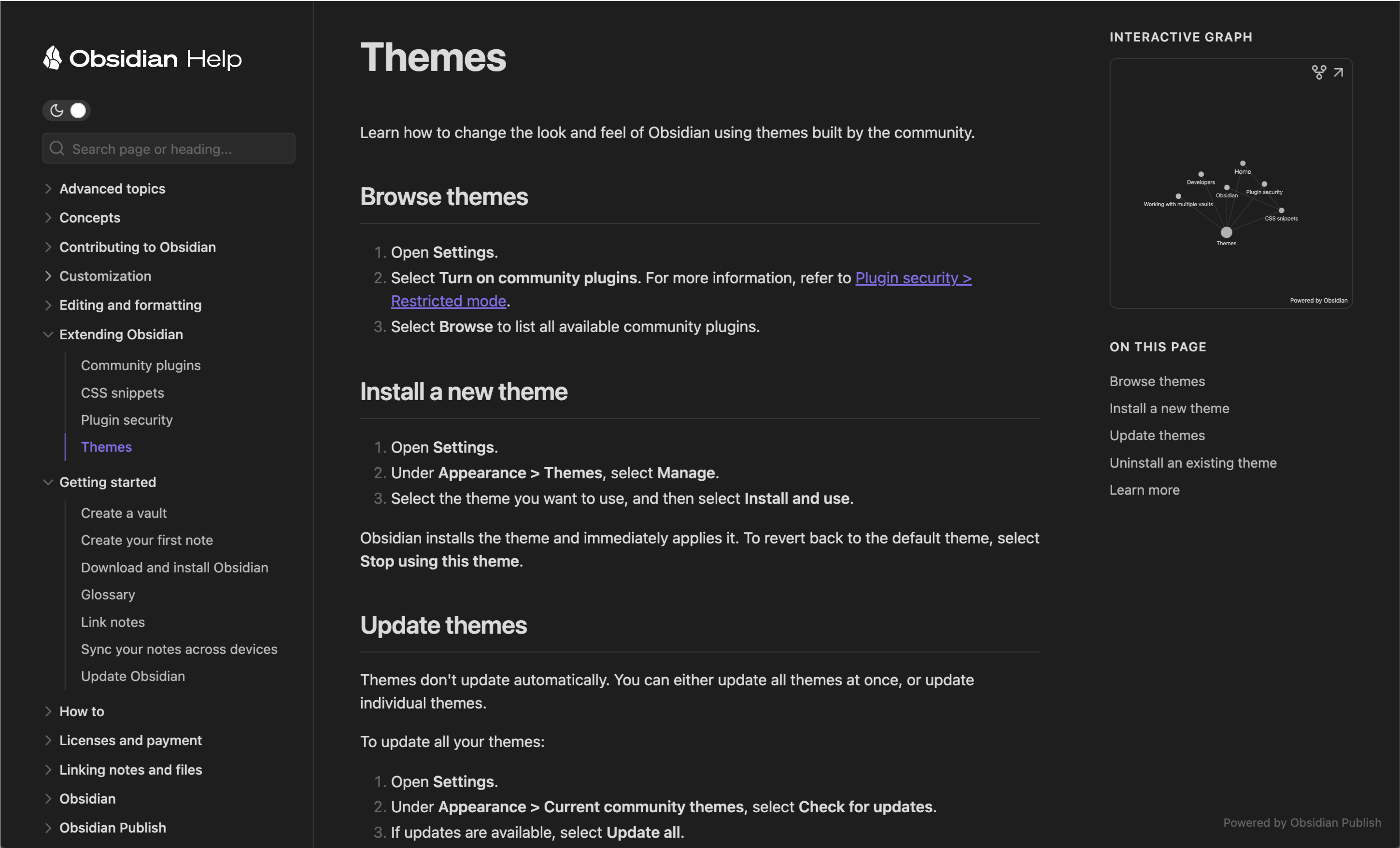
Obsidian Publish (optional paid service) lets you selectively publish notes from your vault as a public website with a single click. The published site preserves bidirectional links, the graph view, and your theme. Many researchers, writers, and developers use Publish to create public digital gardens, documentation sites, and personal wikis — all managed entirely from within Obsidian.
Obsidian vs Notion vs Roam vs Logseq — Full Comparison
How does Obsidian compare to other leading note-taking and personal knowledge management apps in 2025?
| Feature | Obsidian | Notion | Roam Research | Logseq | Evernote | Bear |
|---|---|---|---|---|---|---|
| Free for personal use | ✅ Free | ✅ Free tier | ❌ $15/mo | ✅ Free | ⚠️ Limited | ⚠️ Freemium |
| Local-first storage | ✅ Always | ❌ Cloud only | ❌ Cloud only | ✅ Always | ❌ Cloud only | ❌ Cloud only |
| Plain Markdown files | ✅ Native | ❌ No | ❌ No | ✅ Native | ❌ No | ⚠️ Partial |
| Bidirectional links | ✅ Core | ⚠️ Partial | ✅ Core | ✅ Core | ❌ No | ✅ Yes |
| Graph / knowledge map | ✅ Built-in | ❌ No | ⚠️ Basic | ✅ Built-in | ❌ No | ❌ No |
| Community plugins | ✅ 1,000+ | ⚠️ Limited | ⚠️ Few | ✅ Many | ⚠️ Few | ❌ None |
| Canvas / whiteboard | ✅ Built-in | ✅ Yes | ❌ No | ❌ No | ❌ No | ❌ No |
| Works fully offline | ✅ Always | ⚠️ Limited | ❌ No | ✅ Always | ⚠️ Limited | ⚠️ Limited |
| Windows app | ✅ Yes | ✅ Yes | ❌ Web only | ✅ Yes | ✅ Yes | ❌ No |
| macOS app | ✅ Yes | ✅ Yes | ❌ Web only | ✅ Yes | ✅ Yes | ✅ Yes |
| Linux app | ✅ Yes | ❌ No | ❌ Web only | ✅ Yes | ❌ No | ❌ No |
| iOS & Android app | ✅ Yes | ✅ Yes | ⚠️ iOS only | ✅ Yes | ✅ Yes | ⚠️ iOS only |
| Custom CSS themes | ✅ Yes | ⚠️ Limited | ❌ No | ✅ Yes | ❌ No | ⚠️ Limited |
| YAML frontmatter / metadata | ✅ Native | ✅ Database | ⚠️ Partial | ✅ Native | ❌ No | ❌ No |
| End-to-end encrypted sync | ✅ Paid add-on | ❌ No | ❌ No | ⚠️ Third-party | ❌ No | ❌ No |
| Publish to web | ✅ Paid add-on | ✅ Yes | ❌ No | ❌ No | ❌ No | ❌ No |
| No vendor lock-in | ✅ Open files | ❌ Export limited | ❌ Limited | ✅ Open files | ❌ Proprietary | ❌ Proprietary |
| API / developer docs | ✅ Full API | ✅ Full API | ⚠️ Limited | ✅ Yes | ✅ Yes | ❌ No |
⚠️ = partial support or limited free tier. Last updated April 2025.
Who Uses Obsidian? Real-World Use Cases
Obsidian adapts to your workflow. Here is how different types of users put it to work every day.
Students & Academics
Build a permanent, interconnected set of lecture notes. Link concepts across courses. Create literature notes from papers and connect them to your own ideas. Many students use the Zettelkasten method in Obsidian to build a second brain that compounds in value across their entire academic career.
Writers & Authors
Plan and draft novels, essays, scripts, and articles. Keep character sheets, plot outlines, world-building notes, and research all linked in one vault. Use the Canvas to map narrative structure visually. Many professional writers use Obsidian because their entire manuscript lives in plain text files — future-proof, version-controllable, and never at risk of a cloud outage.
Software Developers
Maintain a personal engineering wiki of architecture decisions, code snippets, runbooks, API references, and post-mortems. Use Dataview queries to create dynamic dashboards of open tickets and project status. Because Obsidian vaults are just folders, they integrate naturally with Git for version control and team sharing.
Researchers & Scientists
Track literature, hypotheses, and experimental results. Use the Zotero integration plugin to pull citations directly into Obsidian notes. Link primary sources to your own analysis notes. Build a knowledge base that spans years of research and reveals cross-disciplinary connections through the graph view.
Project Managers & Consultants
Track clients, projects, meetings, and action items in a private, offline-first vault. The Tasks plugin provides cross-vault task management with due dates and priorities. Dataview queries can surface all open tasks across every project with a single line of code. Everything stays on your machine — no client data in third-party clouds.
Lifelong Learners
Capture ideas from books, podcasts, articles, and conversations. Use the Readwise integration to automatically import your highlights. Connect new information to what you already know. Over time, your vault becomes a personalised encyclopedia of everything you have learned — growing more valuable with every note you add.
Frequently Asked Questions About Obsidian
Everything you need to know before you download Obsidian.
Step-by-step installation guide
Full Obsidian installation guide for Windows, macOS, Linux, Android and iOS — with error fixes, video and FAQ.
Advanced / Power Users
Full Markdown syntax reference, proven vault structure methods (PARA, Zettelkasten), and the top 10 automation plugins — Dataview, Templater, QuickAdd and more.
Obsidian Sync & Backup
Sync between devices with iCloud, Dropbox or Obsidian Sync. Back up your vault with Git or cloud storage. Full guides included.
Obsidian Errors & Fixes
Not installing on Windows 11, blank screen, install stuck, won't open, reinstall without losing notes — all fixes in one place.
Install Obsidian on Any Platform
Follow this step by step Obsidian installation guide for every platform. To install Obsidian on Windows, download the .exe installer and run it — no admin rights needed. To install Obsidian on Mac, open the .dmg and drag the app to Applications. To install Obsidian on Linux, make the AppImage executable and launch it directly. For mobile, learn how to install Obsidian on Android via Google Play, or how to install Obsidian on iOS from the App Store — both are free. For Obsidian setup after installation: open the app, create a vault folder, and write your first note. To learn how to start using Obsidian, explore the built-in Help vault — it covers links, tags, plugins, and the graph view step by step.
Obsidian Installation Guide
This Obsidian installation guide covers everything you need to get started on any platform. To install Obsidian on Windows, macOS, or Linux, follow our Obsidian setup tutorial above — the process takes under two minutes. The Obsidian download and install steps are the same everywhere: download the official installer, run it, and create your first vault. If you are searching for how to install Obsidian on Apple Silicon, Ubuntu, or Android, every method is documented in detail on this page. Install Obsidian today — free for personal use, no account required.